When Every Function Has a Valid Priority, How Do You Make a Decision That Actually Sticks?
STOP reopening the same trade-offs meeting after meeting.
The Priority Conflict Resolution Workshop helps your team make competing functional priorities visible, agree on what matters for the project and create a shared decision logic you can actually use to move forward.
Engineering · Quality · Manufacturing · Procurement · Product · Sales …
Bring the project issue that keeps coming back. We’ll look at what is creating the friction and whether the Priority Conflict Resolution Workshop is the right way to resolve it.
Does this sound familiar?
✓ The same trade-off keeps coming back.
A decision appears to be made — then gets questioned, reopened or discussed again in the next meeting.
✓ Different functions are pushing legitimate but competing priorities.
Engineering, Quality, Operations, Product or other functions all have good reasons for what they are protecting.
✓ A milestone, gate, launch or customer commitment is getting closer.
The unresolved conflict is starting to threaten progress, timing or an important project outcome.
✓ Previous priority conflict resolution attempts haven’t created a stable decision.
More meetings, 1:1 conversations or escalation haven’t solved the underlying conflict.
If several of these sound familiar, the team needs a shared basis for deciding what should take priority — and why.
What changes when the team finally has a shared way to decide?
LESS CAPACITY DISAPPEARS INTO COORDINATION
Less repeated discussion, escalation and stakeholder alignment around the same issue.
FUNCTIONAL PRIORITIES BECOME UNDERSTANDABLE
The team sees the goals, risks and constraints driving each position.
TRADE-OFFS BECOME EASIER TO HANDLE
Shared project-level criteria make clear what should take priority — and why.
DECISIONS BECOME CLEARER — AND STICK
The reasoning is explicit, making decisions easier to support and harder to reopen without new information.
The workshop does not remove legitimate differences between functions. It gives the team a better way to work through them.
We don’t start by scoring options. We start by understanding why different functions see the project differently.
How the Priority Conflict Resolution Workshop turns competing priorities into a shared decision logic
1. UNDERSTAND
Make the different functional perspectives visible.
Each function brings its goals, responsibilities, success criteria, risks and concerns into the room so the team can understand what is actually driving different priorities.
2. ALIGN
Strengthen the shared project direction.
Clarify the existing project goal, the benefits of success and the project-level success criteria that should guide later trade-offs.
3. MAKE TENSIONS VISIBLE
Surface the conflicts that are actually slowing the project down.
Map where important goals compete, what is at stake and which tension currently has the greatest impact.
4. PRIORITIZE
Create a shared decision logic
Agree on project-specific criteria and weighting, then apply them to a real trade-off so the assumptions behind the decision become explicit.
5. APPLY
Turn the workshop into something the team can keep using.
Confirm decisions, document open issues and define how the outputs will be used when future conflicts arise.
The result is not a generic prioritization framework. It is a project-specific decision system built around the realities of your team and your project.
You don’t leave with sticky notes. You leave with a decision system your team can keep using.
01 — FUNCTIONAL PERSPECTIVE OVERVIEW
A clear view of what each function is trying to achieve, what it is responsible for, how success is measured and what risks or constraints are driving its priorities.
02 — SHARED PROJECT GOAL & SUCCESS CRITERIA
A common project-level reference point the team can use when individual functional priorities start pulling in different directions.
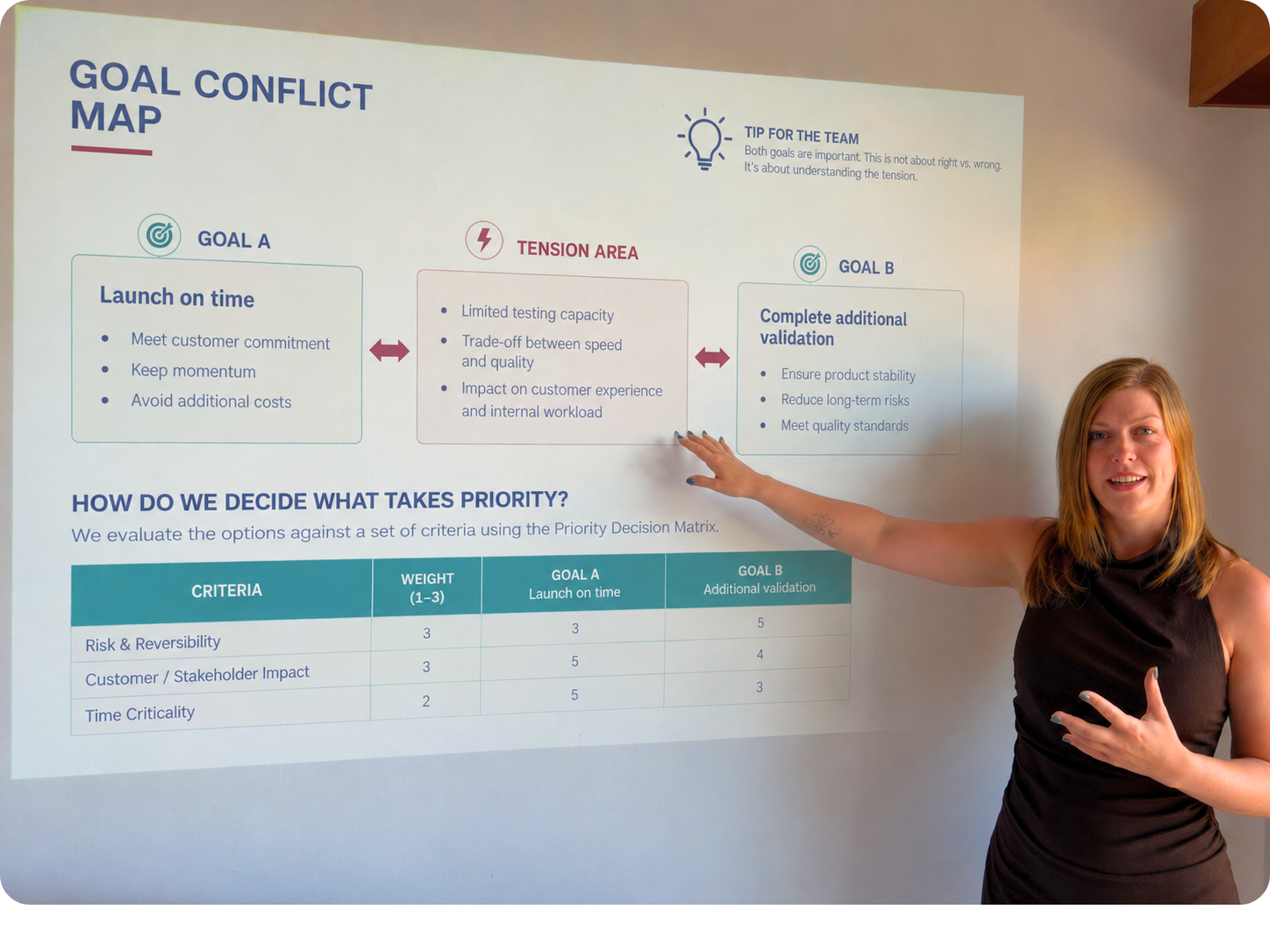
03 — GOAL CONFLICT MAP
A visible picture of the most important competing goals, why the tension exists and what is actually at stake.
04 — PRIORITY DECISION MATRIX / SHARED DECISION LOGIC
A project-specific basis for evaluating genuine trade-offs more consistently and transparently — including the assumptions behind the decision.
PLUS: DOCUMENTED OPEN ISSUES & NEXT STEPS
Remaining uncertainties, missing information and follow-up actions are captured instead of disappearing into another meeting.
So when the next conflict appears, the team already has a shared system for turning it into a decision.
Is this the right workshop for your team?
The Priority Conflict Resolution Workshop works best when there is a real project, a real cross-functional trade-off and genuine room to influence the decision.
A strong fit if…
several functions have legitimate but conflicting priorities
an important decision is stuck or repeatedly reopened
the issue is causing delay, rework, escalation or repeated coordination
the relevant functions have genuine room to influence the trade-off
Probably not the right fit if…
the decision has already been made
the core problem is primarily interpersonal
critical functional perspectives cannot participate
the issue is mainly a resource, governance or authority decision outside the team’s influence
If you are unsure whether the issue fits the workshop, that is exactly what we clarify in the Project Fit Call.
What the engagement looks like
01 — PREPARE
Walk into the workshop ready to work on the real issue — not spend the morning explaining it.
Before the workshop, I clarify the project context, the relevant stakeholders, the decision boundaries and the known tensions with the sponsor. Participants also complete a short pre-workshop survey and prepare their functional perspective.
02 — WORKSHOP DAY
Work through the real conflict together.
In a full-day facilitated session, the team moves through the five-step process: UNDERSTAND → ALIGN → MAKE TENSIONS VISIBLE → PRIORITIZE → APPLY. The session is typically designed for around 6–8 participants.
03 — DOCUMENT
Leave with something the team can actually use.
The completed workshop outputs, decisions, open issues and next steps are captured and documented digitally so the result does not disappear into meeting notes.
04 — FOLLOW UP
Check whether the logic still works when real project life resumes.
After approximately 4–6 weeks, we review whether the outputs are still being used, whether relevant trade-offs have been handled with the shared decision logic and where friction remains.
FORMAT
Full-day workshop
GROUP SIZE
Typically 6–8 participants
DELIVERY
Remote or on-site
INCLUDED
Preparation · Workshop · Digital documentation · 4–6 week follow-up
One structured day to deal with the conflict properly — instead of paying for it again in the next three meetings.
The workshop costs one day. The unresolved conflict can cost you weeks.
What does one unresolved trade-off actually cost?
8 people × 90 minutes × 3 meetings = 36 working hours
36 HOURS — BEFORE ANY REWORK OR DELAY
At an illustrative €100 loaded cost per hour, that is already €3,600 in meeting time alone.
And meeting time is rarely the biggest cost. Add rework, waiting, escalation, stakeholder coordination and delayed milestones.
The real question is how much more project capacity you want to spend on the same unresolved trade-off.
The Not-Just-Another-Workshop Guarantee
You won’t spend a full day discussing the same issues only to leave with vague conclusions and a wall full of sticky notes.
By the end of the Priority Conflict Resolution Workshop, your team will have:
made the key functional perspectives behind the conflict visible
identified the real cross-functional trade-off
built a shared, project-specific decision logic
applied that logic to a real priority decision from your project
If we cannot achieve the agreed workshop outputs during the session, I will facilitate an additional 90-minute working session at no additional cost.
The guarantee applies when:
the relevant functions participate, preparation is completed and there is genuine room to influence the trade-off.
Built for technical teams by someone who has worked inside them.
My background is in technical project, development and production environments where Engineering, Quality, Manufacturing and other functions regularly had valid — but competing — priorities.
That experience shapes my approach: understand the system behind the friction before trying to fix the people inside it.
I know what it feels like when capable people are all trying to do the right thing — and the system still makes progress harder than it should be.
A structured way to resolve the trade-off — before it keeps costing your project time.
The Priority Conflict Resolution Workshop
€3,500 net
Includes:
Preparation · Full-day facilitated workshop · Digital documentation · 4–6 week follow-up
Pilot Offer Available for the First 3 Engagements
€3,500 net
€1,500 net pilot investment
The workshop itself follows the complete process described on this page. In return, I’ll ask for detailed feedback afterwards so I can refine the format based on real technical project cases.
Available for the first three pilot engagements only.
Not sure whether your issue fits the workshop?
Bring the trade-off that keeps coming back. In a 30-minute Project Fit Call, we’ll identify what is keeping it stuck and whether the Priority Conflict Resolution Workshop is the right intervention.
Still wondering whether this is worth bringing your team into?
Questions teams usually have before booking
-
The workshop is built around a real project issue and concrete outputs — not generic discussion.
Your team works through the actual functional conflict, creates a shared project-specific decision logic and applies it to a real trade-off.
If the agreed workshop outputs are not achieved, the Not-Just-Another-Workshop Guarantee includes an additional 90-minute working session at no additional cost.
-
They may — and that is not a failure.
Priority Conflict Resolution does not mean everyone has to prefer the same option. It means the team understands the trade-off, the reasoning behind the decision and the shared logic used to make it.
The goal is not artificial consensus. It is a decision the team can understand, accept as legitimate and work with.
-
The team does not leave with a generic framework or a set of workshop notes.
The decision logic is developed around your real project and documented so it can be referred back to when similar trade-offs appear again.
A 4–6 week follow-up also checks whether the outputs are still being used and where friction remains.
-
Because the unresolved conflict is already taking time out of the project.
Repeated meetings, reopened decisions, stakeholder alignment, escalation and rework all consume project capacity — just in smaller pieces that are easier to overlook.
The workshop concentrates that effort into one structured day instead of letting the same issue keep consuming time over several weeks.
-
The relevant comparison is not another workshop. It is the cost of leaving the conflict unresolved.
Repeated meetings, coordination, delay, escalation and potential rework can quickly consume dozens of working hours.
The workshop also creates a shared decision logic that can be reused when future trade-offs appear.
-
You can use prioritization tools and templates internally. What is harder to create internally is neutral facilitation.
The value of this workshop is not the templates — it is the facilitated process around it.
An external facilitator has no preferred outcome. I keep the process structured, make every perspective visible and help the team reach its own conclusion — without steering the decision or imposing an answer.
-
Those tools solve different parts of the problem.
Jira can make work visible. RACI can clarify responsibility. Prioritization frameworks can structure scoring.
What they do not automatically create is a shared understanding of why different functions evaluate the same trade-off differently — or which project-level logic should determine what takes priority.
That understanding matters. People resist decisions they are simply expected to accept. When the reasoning is clear, they are far more likely to accept and support the decision — even when it is not their preferred outcome.
-
Then the scope should be adjusted or the workshop postponed until the critical perspectives can participate.
If an important function carries a relevant responsibility, risk or downstream consequence but is missing, the group may be making the decision without essential information.
The workshop should not create false alignment.
-
Then the Priority Conflict Resolution Workshop is probably not the right format.
The process requires genuine room to discuss and influence the trade-off. It should not be used to create artificial participation or buy-in around a decision that is already fixed.
-
It can — but the conflict usually keeps consuming capacity while you wait.
If the issue is already causing repeated meetings, chasing, escalation or rework, postponing the conversation does not remove the cost.
One structured day may be less disruptive than carrying the same unresolved issue through another several weeks of project work.
If the same trade-off keeps coming back, bring it to the call.
We’ll look at what is keeping the decision stuck and whether the Priority Conflict Resolution Workshop is the right way to move it forward.